


YPSILANTI TOWNSHIP, Mich. (WXYZ) — A controversial $1.25 billion data center development in Ypsilanti Township has elected officials in the community and the University of Michigan at odds over the proposed facility and its partnership with Los Alamos National Laboratory.
Watch Brett Kast's video report:
The University of Michigan says the project isn't a typical data center but rather a "high-performance computational facility" that will help drive research and development. However, the proposed facility has sparked concern among some residents and local officials.
PREVIOUS STORY: University of Michigan to build AI research facilities in Ypsilanti Township, sparking mixed reactions
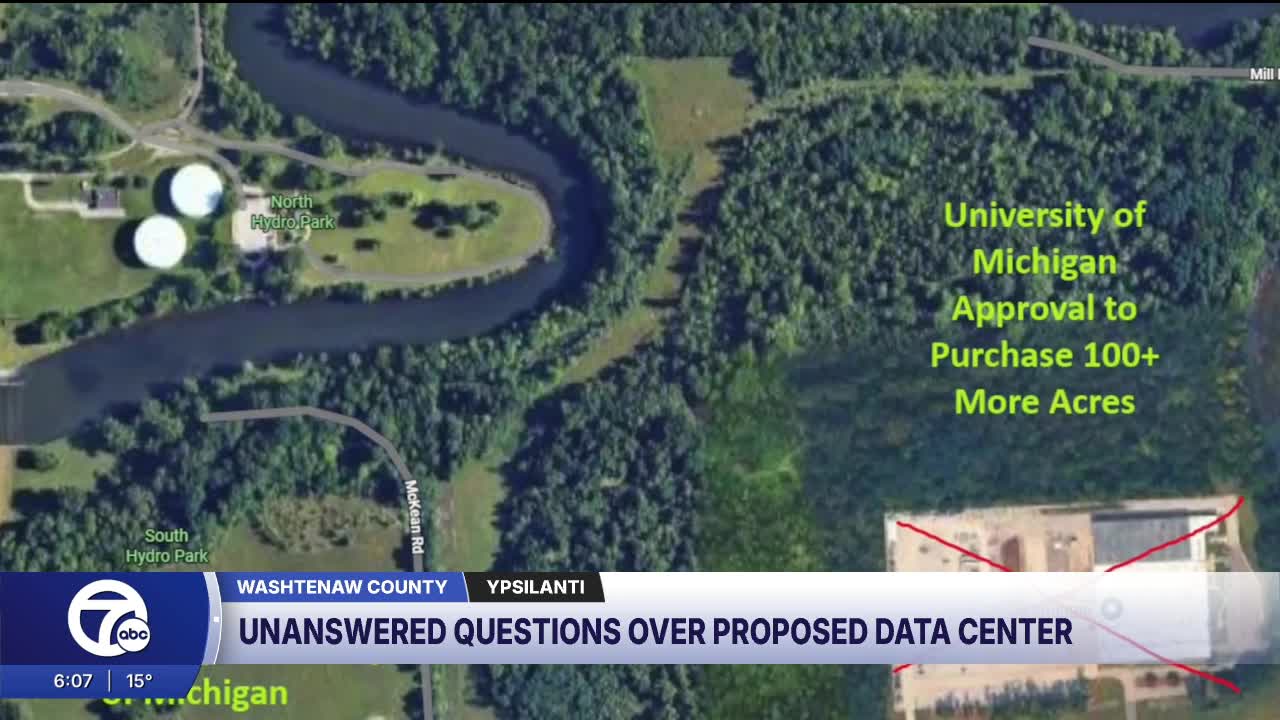
The university says a final site for this project has not been determined, but during a recent town hall, they showed plans for two different sites in Ypsilanti Township. Township officials say one of the sites is far from ideal.
"This is not industrial land, this is our open woods and forest and habitat," said Crystal Lecoq, an Ypsilanti Township resident who often visits the township park near one of the potential sites.

Standing at the entrance to the South Hydro Park, Lecoq expressed worry about what's to come if plans for the facility move forward in the lot next door.
"I feel overall, Michigan is feeling inundated with data center projects,” said Lecoq. "People are rightfully concerned, and then you throw in possibly military industrial complex development, no taxes."
The project is a partnership between the University of Michigan and Los Alamos National Laboratory, famously known for its role in developing the first atomic bomb. The university says this project is one-tenth the size of a commercial data center and instead calls it a high-performance computational research facility with two separate parts: an academic computing center for the university and a classified site for Los Alamos scientists and researchers focused on critical national security.
The classified national security component has caused concern among some residents, with an online petition calling for an end to the partnership.
"There's no way to guarantee that this facility wouldn't be doing computational models for weapons of destruction and war, and I think that ignites a lot of passion from folks," Lecoq said.
PREVIOUS STORY: Data center deep dive: A look at metro Detroit proposals & why the area is prime for AI developments
In an online FAQ section, the university says the facility will not manufacture nuclear weapons, but is rather for research and high-performance computing.
"It will focus on scientific computation to address various national challenges, including cybersecurity, nuclear and other emerging threats, biohazards, and clean energy solutions," the website reads.
Township Attorney Doug Winters says the township's concerns over the site location, due in part to wildlife and woodland impacts, have gone unanswered. Since the university is exempt from their zoning and ordinances, he says the township gets no tax revenue and no say in the development.
"We do know that Los Alamos has been referred to as being a high-value target, and they should not be located near residents, they should not be located on the banks of the Huron River, and we should have a say so," Winters said. "They operate in a shroud of secrecy; they will not give us their plans. We have no idea what they're doing."

The university and Los Alamos did host an open house for the public on Thursday, with about 400 people in attendance. Project lead and Professor of Engineering Steven Ceccio said the project will bring some of the world's most brilliant scientific minds to Michigan, providing a powerful resource for students and faculty while applying pioneering computing techniques to the work of University of Michigan researchers in medical, energy, and environmental studies.
The University says the project will also create 200 jobs.
Congresswoman Debbie Dingell had publicly pushed for a public meeting to be held by the university, but afterwards said the meeting failed to address concerns and emphasized a lack of transparency.
In a letter sent to University of Michigan President Grasso, Rep. Dingell said:
The community wants and should have a forum where questions are asked and answered publicly... Instead, the open house was structured as many residents described it as a show-and-tell rather than providing a forum for any meaningful dialogue. Without the opportunity for this dialogue, residents left without a clear understanding of the facts and without answers to their questions... What is needed now is a formal, public town hall in Ypsilanti Township that brings the experts together to answer communication in an open and collective setting. Residents have been asking for this for more than a year. The community needs clarity and accountability.
Construction on the project is expected to begin in 2027, with the facility becoming operational in 2031.
Representatives from Los Alamos were in person at the meeting on Thursday to address questions from the community, but were traveling and unavailable for an interview on Friday.
———————————————————
This story was reported on-air by a journalist and has been converted to this platform with the assistance of AI. Our editorial team verifies all reporting on all platforms for fairness and accuracy.
